Everything done to the back was done to save the front, and the front ends up recording all of it.
Photograph supplied.
When the support itself becomes the problem
Transferring a painting means removing the original support entirely — every last fibre of canvas, every sliver of wood — and bonding the paint film to a new carrier. It is the most drastic intervention in conservation, and it cannot be undone.
The procedure was developed in eighteenth-century France, where transposition became fashionable partly as a technical feat and partly because deteriorating supports were genuinely threatening fragile surfaces. For panel paintings, the process typically involved facing the paint film with tissue or fabric to protect it, then grinding or planing away the wood from behind — a process that continues through ground and sometimes into the lowermost paint layers before stopping at a depth the operator judges safe. What is left is a membrane, fragile and entirely reliant on whatever support comes next, usually canvas or a rigid composite.
The losses are categorical. Oak carries information: the grain, the quarter-sawn cut, the bevels at the edge where the original frame rabbeted in, the marks on the back. All of that disappears. So does the mechanical relationship between wood and ground that the crack network had spent centuries encoding — cracks that, in a transferred painting, no longer correlate to anything in the new support and can mislead every subsequent reading of the surface.
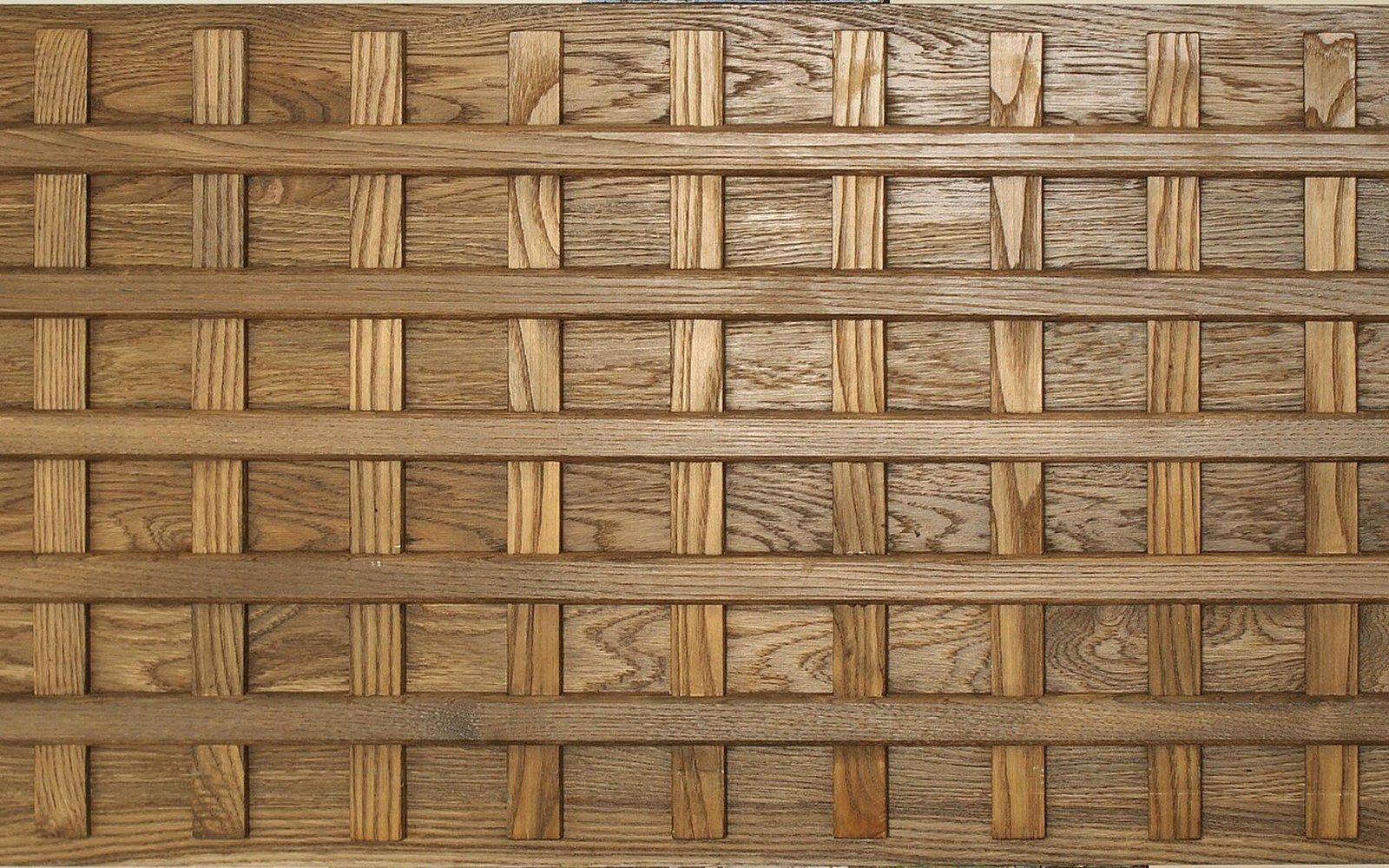
Fixed members one way, sliding members the other. When the sliding members seize, the lattice stops guiding the board and starts clamping it.
Photo: Доска для живописи с дубовым паркетажем · Wikimedia CommonsEven when the procedure is executed without visible incident, there are long-term consequences. The paint film no longer sits on the substrate it was made for. Adhesion, flexibility, and response to humidity are all altered. Paintings transferred onto canvas have developed new crack patterns driven by canvas movement rather than wood. Those transferred onto rigid secondaries have fared somewhat better, but no replacement support replicates oak's original behaviour across centuries.
Transfer is now reserved for situations where a panel is so compromised — by active cleavage, insect damage or fire and water — that the choice is between losing the painting and losing the support. That framing is accurate, but it demands honest accounting: what survives after transfer is the image, not the object. Both are worth preserving; they are not the same thing.
Transferring a painting means removing the original support entirely — every last fibre of canvas, every sliver of wood — and bonding the paint film to a new carrier.
The cost of the procedure
Lifted out of the piece| Facing | protective tissue or fabric applied over the paint surface before any mechanical work begins |
| Transposition | the French term for transfer; coined in the eighteenth century, when the practice spread |
| Paint membrane | what remains once wood and ground are fully removed: a layer of microns, unsupported |
Two boards glued edge to edge. The glue is meant to be the weakest part of the assembly.
Photo: Digital Buggu / Pexels