Battens
Before the cradle, there was the batten: a strip of wood glued or nailed across the grain to hold a panel flat. It rarely did.
Everything done to the back was done to save the front, and the front ends up recording all of it.
Photo: Matthias Fiesel / Pexels
A simple idea with a complicated failure mode
The logic seemed sound. A panel warps because oak moves with changes in humidity — swelling across the grain, shrinking back, slowly bowing over decades. Glue a stiff strip of wood perpendicular to that grain, and the strip should hold the board level. In practice, it transferred the stress rather than resolving it.
Battens appear on the backs of Netherlandish panels from the fifteenth century onward, sometimes in the original construction, sometimes added later by owners trying to correct a warp that had already developed. They were typically oak themselves, occasionally a softer wood, and were either glued flat across the back or fixed with iron nails or wooden pegs. A few survive in near-original condition; many were removed by later restorers who replaced them with the cradle — the sliding lattice that dominated panel treatment from the eighteenth century until well into the twentieth.
The trouble with a rigid batten is that the panel beneath it never stops responding to humidity. In dry conditions the oak wants to shrink; the batten will not allow it. The wood has nowhere to go, so stress accumulates and eventually something breaks — not the batten, but the paint and ground above it, which crack in a line that tracks the batten's edge with uncomfortable precision. Conservators examining a panel with a straight run of losses or a pronounced ridge in the crack network will turn it over and look for exactly this: a batten removed long ago, or still in place, whose presence explains every surface problem directly above it.
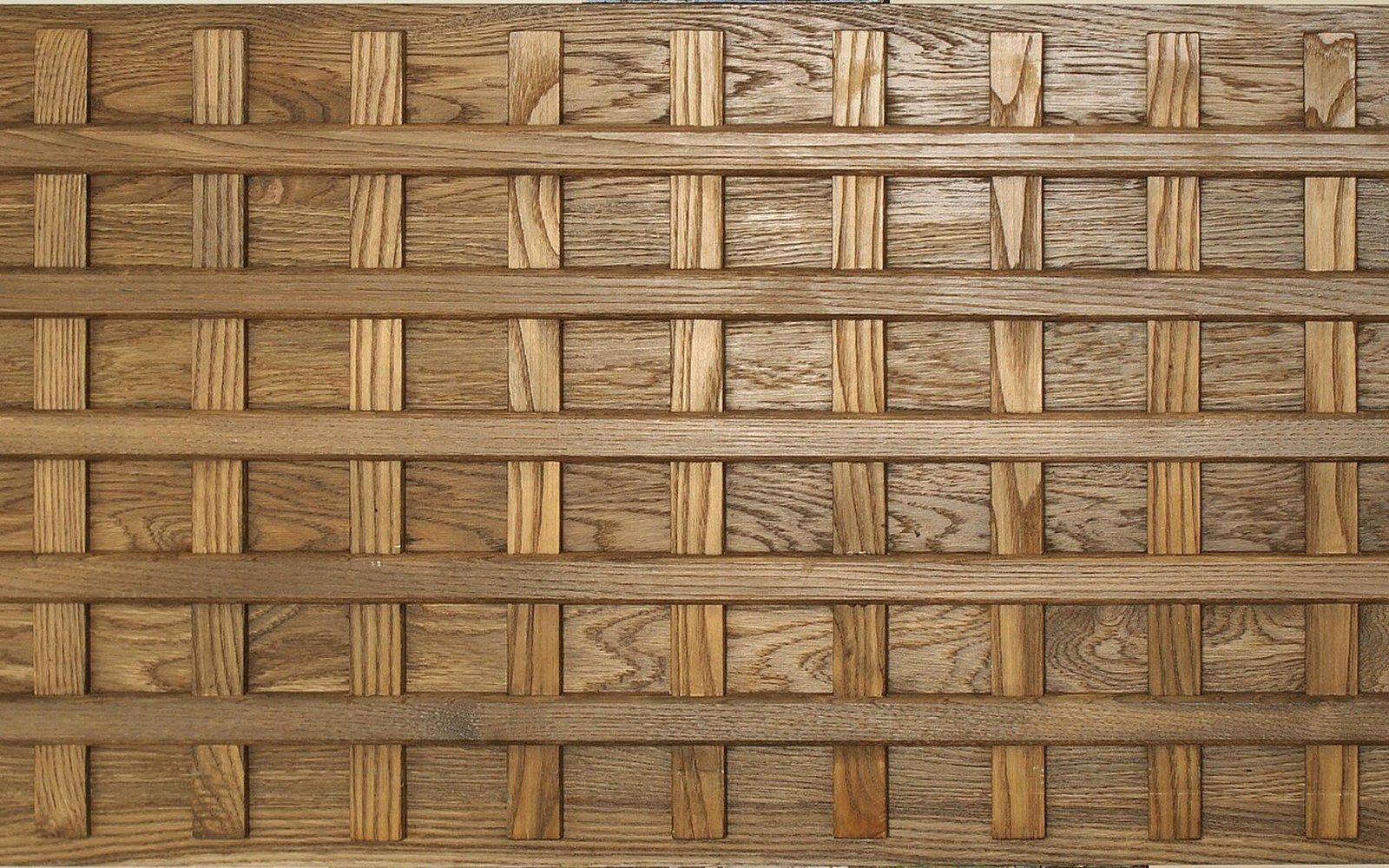
Fixed members one way, sliding members the other. When the sliding members seize, the lattice stops guiding the board and starts clamping it.
Photo: Доска для живописи с дубовым паркетажем · Wikimedia CommonsWhere battens were nailed rather than glued, the nails corroded and expanded, driving small eruptions through the chalk ground to the paint surface. Where they were glued with animal glue across a wide face, the composite — stiff strip over flexible panel — fought itself every winter and summer for centuries.
Removing a batten is not straightforward. The glue is often stronger than the wood below it, and the panel may have deformed around it so completely that removal introduces new movement. Sometimes a batten that is causing no acute damage is left in place, monitored, and treated as a fixed condition rather than a problem to solve.
A panel warps because oak moves with changes in humidity — swelling across the grain, shrinking back, slowly bowing over decades.
What goes wrong, and where to look for it
Lifted out of the piece| Ridge or straight crack run on the paint surface | look for a batten on the reverse at the same position |
| Nail-related eruptions | small, localised, evenly spaced surface disturbances tracking an iron fixing |
| Deformation around the batten | the panel has curved to accommodate it; removal changes the stress pattern |
| Glue failure | when the batten lifts, it can pull ground with it |
Two boards glued edge to edge. The glue is meant to be the weakest part of the assembly.
Photo: Digital Buggu / Pexels