Chalk and glue
The chalk ground is not a coating; it is a foundation — absorbent, brilliant white, and brittle enough to crack before the paint above it does.
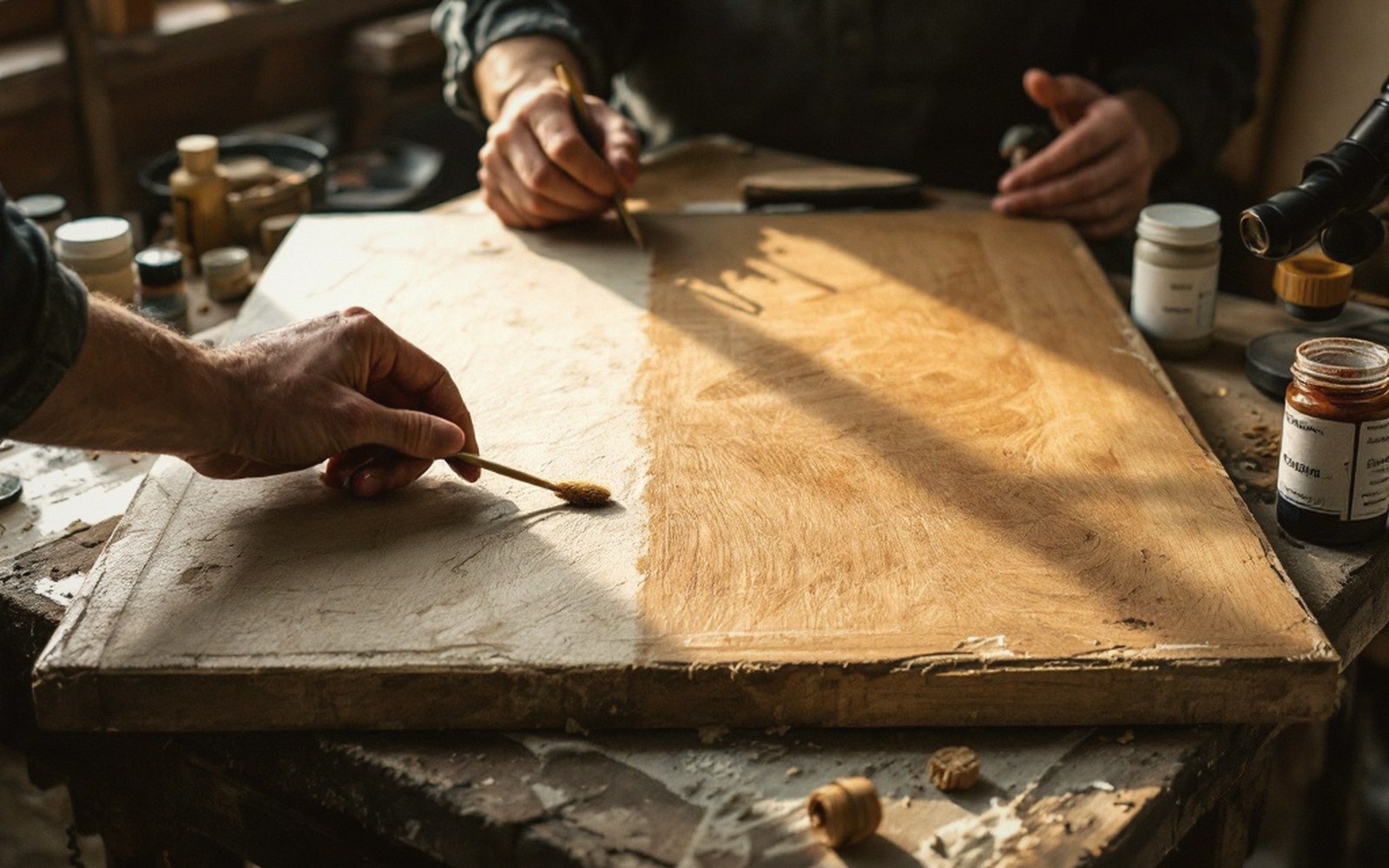
The ground is rigid, brittle with age, and glued to something that moves. That is the whole problem in one sentence.
Photograph supplied.
What the Ground Is Made Of
Strip the varnish, the paint and the imprimatura from a Flemish or Dutch panel, and what you reach is a chalk ground: calcium carbonate — natural chalk or precipitated whiting — mixed with animal-hide glue and water, then applied in multiple passes with a broad knife or brush. The glue is the binder. The chalk is the filler. Together they make a layer that is rigid when dry, optically white and hungry for oil.
That whiteness matters. Northern painters worked against a brilliant, light-reflective surface so that even the thinnest paint layer could glow. Italian panels of the same period often used gesso grosso and gesso sottile — calcium sulphate in two grades — but the Northern tradition settled on chalk, and the difference shows under analysis: a calcium sulphate ground is denser and smoother; a chalk ground remains slightly granular and far more absorbent, which changes how the first oil layers sink in and grip.
Thickness varied, but a well-built Northern ground is commonly between half a millimetre and one and a half millimetres — laid in perhaps four to eight separate applications, each allowed to dry before the next. The surface was then scraped or pumiced smooth. Those separate layers are sometimes visible in a cross-section sample under the microscope: pale striations, each marking a single pass of the knife. This stratigraphy is evidence, not just for the maker's method, but for any later conservator trying to understand what the panel was designed to do.
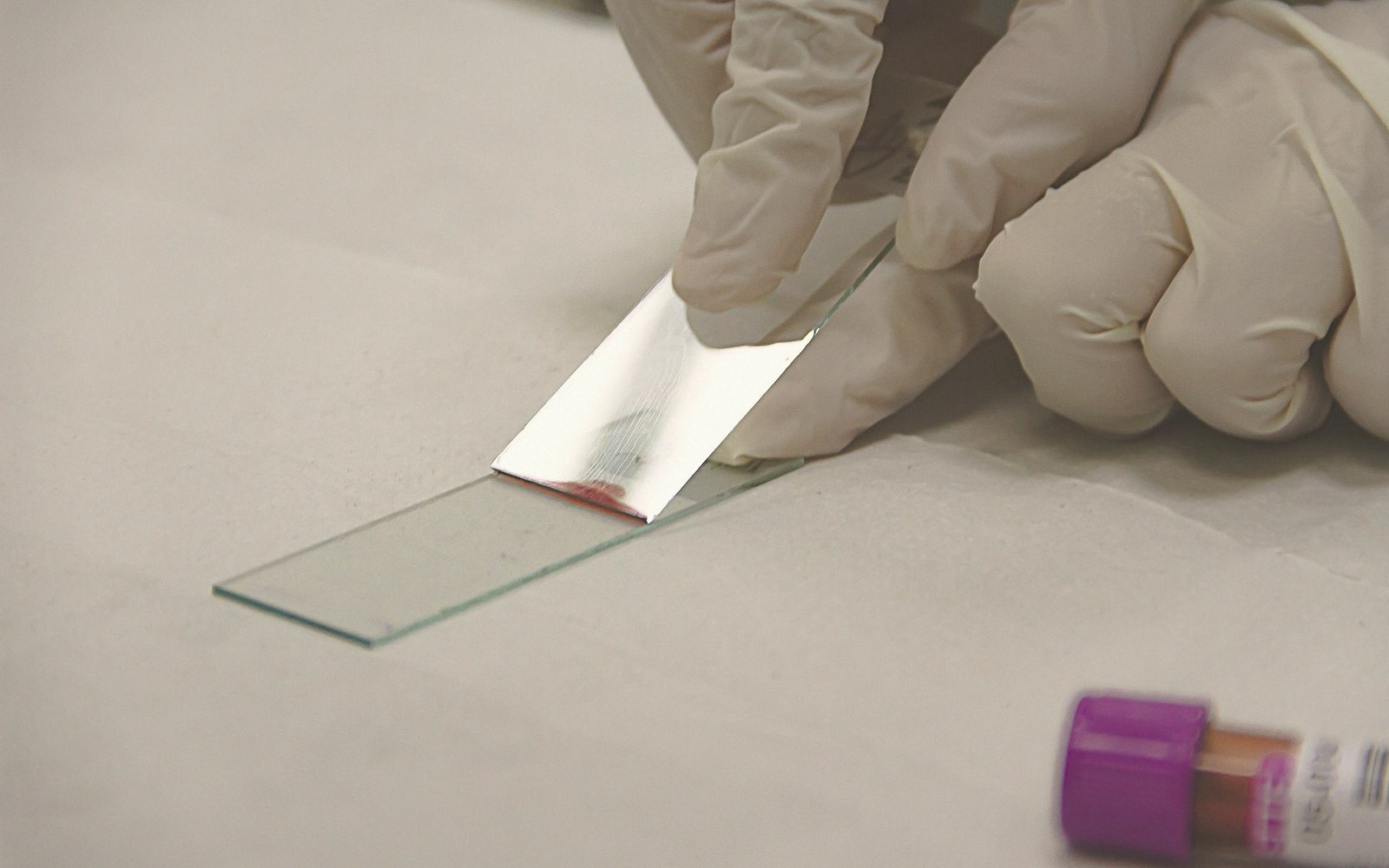
A sample the width of a hair, set in resin and polished, holds the whole build order in view at once.
Photo: roberto carrafa / PexelsWhy It Cups
The ground's brittleness is inseparable from its composition. Chalk and glue expand and contract in response to changes in relative humidity — but they do not do so at the same rate as the oak board beneath them, and they do not do so the same way in every direction. Wood moves mainly across the grain. The chalk ground has no grain; it moves more or less isotropically. This mismatch generates stress, and over centuries, stress wins.
Cupping is what happens when one surface of a plank or panel contracts more than the other. In a panel painting, the chalk ground is hygroscopic — it absorbs moisture readily and swells, then releases it and shrinks. The paint and varnish layers above it are far less permeable. The back of the panel, if bare wood, responds freely to humidity changes. The result is a differential movement that curves the panel and, in the ground itself, generates internal tension. Where that tension exceeds the ground's cohesion, the ground cracks. Where it cracks, it cups — meaning individual tesserae of ground and paint curve upward at their edges like tiny tiles lifting off a floor.
Cupping and flaking is the stage at which the conservator intervenes, but the cause is already locked into the material: a hygroscopic ground on a hygroscopic support, separated from the environment by a relatively impermeable paint film. Everything about the system promotes differential movement. The chalk ground is not failing — it is doing exactly what its physics require.
Northern painters worked against a brilliant, light-reflective surface so that even the thinnest paint layer could glow.
What Survives and What Doesn't
After four centuries in variable environments, collections that have been heated, cooled, flooded or stored, the chalk ground preserves remarkably well where it is undamaged. Its calcium carbonate is chemically stable; it does not yellow, does not oxidise, does not react with the oils above it the way some grounds do. What erodes it is mechanical stress and, critically, past treatment: old consolidants, injected adhesives, the residues of lining attempts. These materials age differently from the chalk, often becoming harder or more brittle than the original, and they alter the very stress pattern they were meant to stabilise.
The ground is also where losses begin. Paint without ground has no purchase. A flake that lifts carries chalk with it, and what is left behind is bare wood — or, in panels that were thinned in the eighteenth or nineteenth century, sometimes no wood at all. In those cases the chalk ground is effectively the structural layer, holding a surface together that has been reduced to almost nothing below it.
The white preparation is not glamorous. No one discusses it the way they discuss glazes or underdrawing. But it is the layer on which everything else depends, and the layer on which almost everything eventually fails.
What the ground is built from
Lifted out of the piece| Calcium carbonate (chalk or whiting) | the filler, optically white and chemically stable |
| Animal-hide glue | the binder, also the source of moisture sensitivity |
| Applied in multiple passes | cross-sections sometimes show four to eight discrete layers |
| Typical thickness | roughly 0.5 mm to 1.5 mm on Northern panels |
| Northern chalk vs. Italian gesso | calcium carbonate vs. calcium sulphate; different absorption, different optical effect |
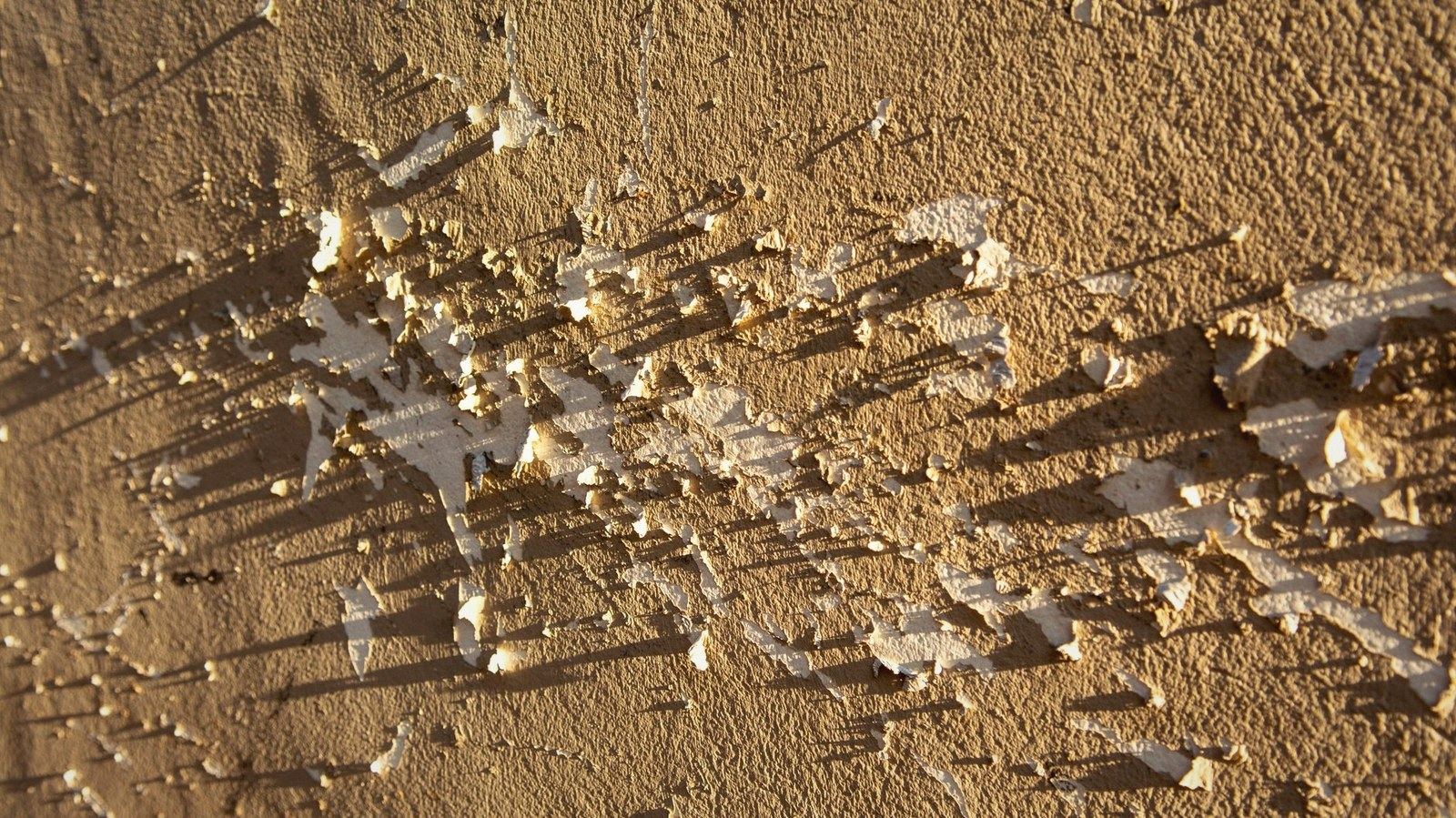
Raking light at a shallow angle turns every deformation in the surface into a shadow — cracks, cupping, and the ridge along a join all read at once.
Photo: Jan van der Wolf / PexelsWhy failure follows the physics
Lifted out of the piece- Chalk ground is hygroscopic; paint film above it is notdifferential response to humidity is built in
- Wood moves mainly across the grain; ground moves in all directionsmismatch generates stress
- Cupping: ground and paint tesserae lift at their edges as internal tension exceeds cohesion
- Old consolidants often harden differently from chalk, altering the stress pattern they were meant to fix