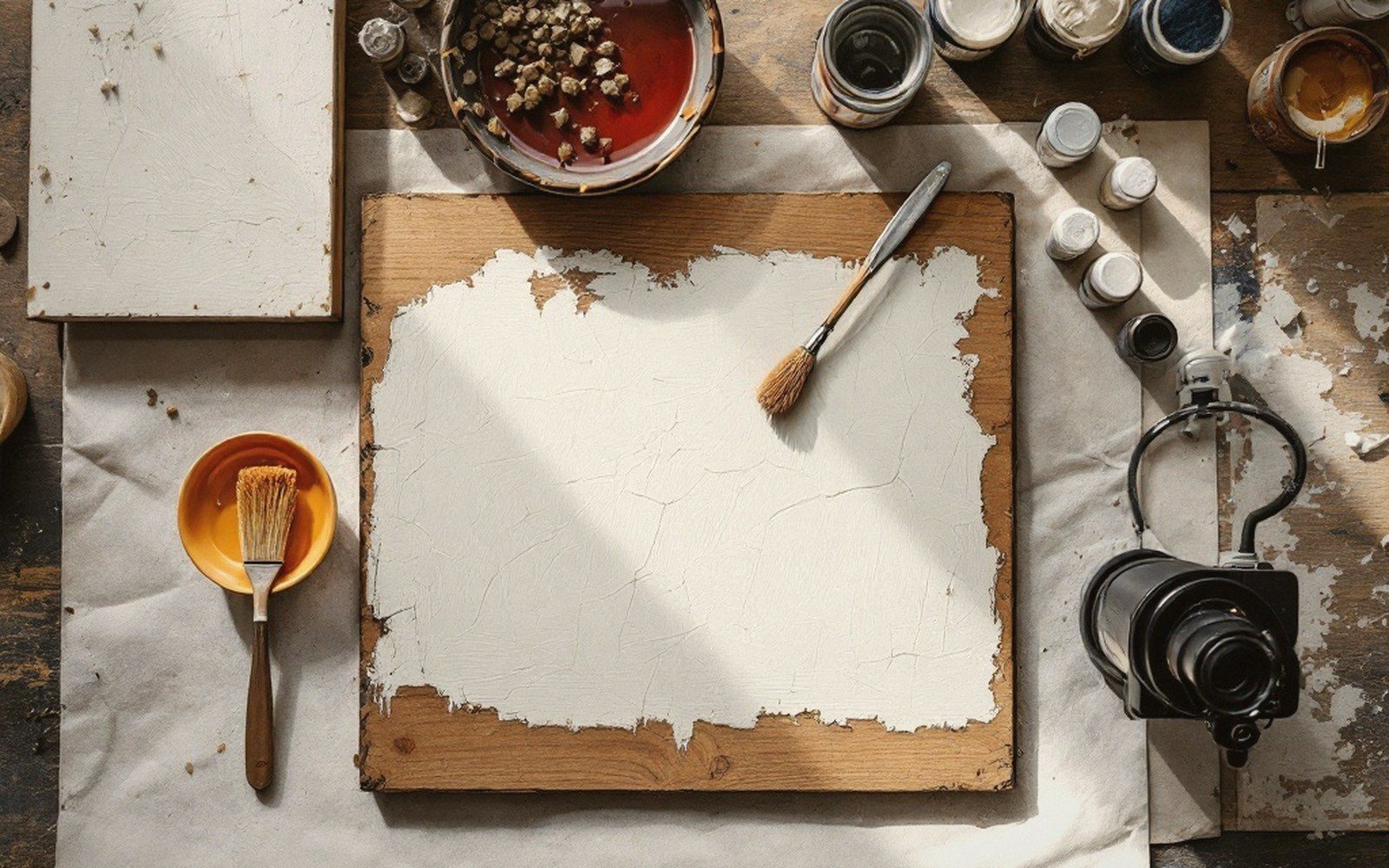
Paint was built up in thin passes, each one relying on the layer beneath it to do part of the work.
Photograph supplied.
The pigment that does most of the work
It is the most common pigment in a Northern European panel painting. Lead white — made by exposing lead to acetic acid vapour in the presence of carbon dioxide, a process already ancient when Flemish painters adopted it — forms the body of nearly every highlight, every flesh tone, and most mixed tints. Without it, a fifteenth-century palette barely functions.
The chemistry matters because it governs how the paint film ages. Lead white is lead carbonate, basic: 2PbCO₃·Pb(OH)₂. It dries by reacting with the linseed oil that carries it, forming lead soaps — lead carboxylate compounds that continue to form for centuries. Those soaps make lead-white paint exceptionally hard and slightly flexible compared with most other pigments in oil. They also make it translucent over time, which is why impastoed highlights lose some of their initial opacity and why pentimenti — underdrawing, revised contours — can surface from beneath passages the painter intended to be opaque.
In the crack network, lead white behaves differently from the ground beneath it. The chalk-and-glue preparation is brittle; the lead-white paint film, toughened by those soap formations, can stay relatively cohesive even when the ground below has fractured. The result is that cracks in lead-white-heavy areas sometimes have a different character from cracks in thinner, leaner passages — wider spacing, smoother edges, less tendency to flake independently. Where the paint is thick — in fully lit flesh or a white linen collar — the film can bridge small ground fractures rather than mirror them exactly.
What a conservator can match is limited by what is in the jars, and by what the original was.
Lead white is also dense. Its high refractive index gives it excellent covering power, which painters exploited to build opacity quickly in a few passes rather than many. Mixed into a glaze sequence, even a small proportion shifts the layer from transparent to translucent, altering depth without obliterating it. Mixed with smalt or azurite for sky tones, it carries those vulnerable blues into the upper paint layers where they are most exposed to light — a practical choice that has not always aged gracefully.
One caution for anyone standing close to the surface under raking light: the slight sheen on a lead-white highlight is not always varnish residue. The lead soaps themselves can migrate toward the surface, forming a thin, semi-glossy skin — plumbonacrite has been identified in some aged lead-white films — that a cleaner unfamiliar with the phenomenon might mistake for grime. The difference matters. One wipes off; the other is the paint.
It dries by reacting with the linseed oil that carries it, forming lead soaps — lead carboxylate compounds that continue to form for centuries.
What it is made of
Lifted out of the piece| Lead white | basic lead carbonate, 2PbCO₃·Pb(OH)₂; made by corroding lead sheet in acetic acid vapour and carbon dioxide |
| Lead soaps | compounds that form as lead reacts with linseed oil; make the film hard and increasingly translucent over centuries |
| Plumbonacrite | a lead compound identified in the surface skin of some aged lead-white paint films; not a contaminant |
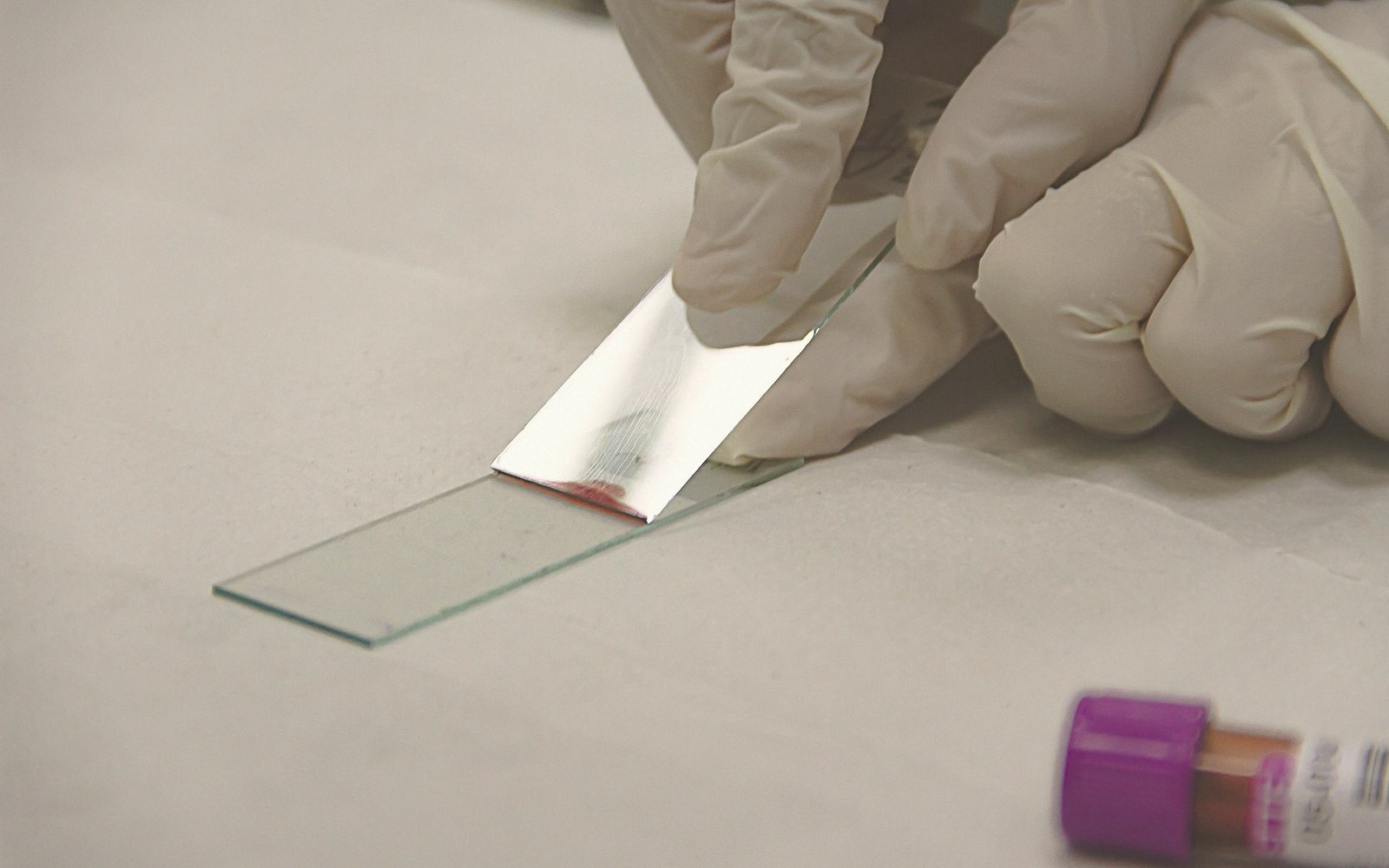
A sample the width of a hair, set in resin and polished, holds the whole build order in view at once.
Photo: roberto carrafa / PexelsHow it behaves over time
Lifted out of the piece- Translucency increases as lead soaps form andcan reveal underdrawing and pentimenti from beneath opaque passages
- Dense film may bridge small ground fractures rather than crack in exact register with the ground below
- Surface sheen on highlights may be migrated lead soap, not varnish residue;the distinction is diagnostic before any cleaning